

Voice Data Cabling Services in Austin
Business Communication Solutions specializes in the design and installation of voice and data cabling networks. Our goal is to provide our clients with excellent, affordable service they can rely on. Give us a call to help design and deploy the right cabling system for your needs.
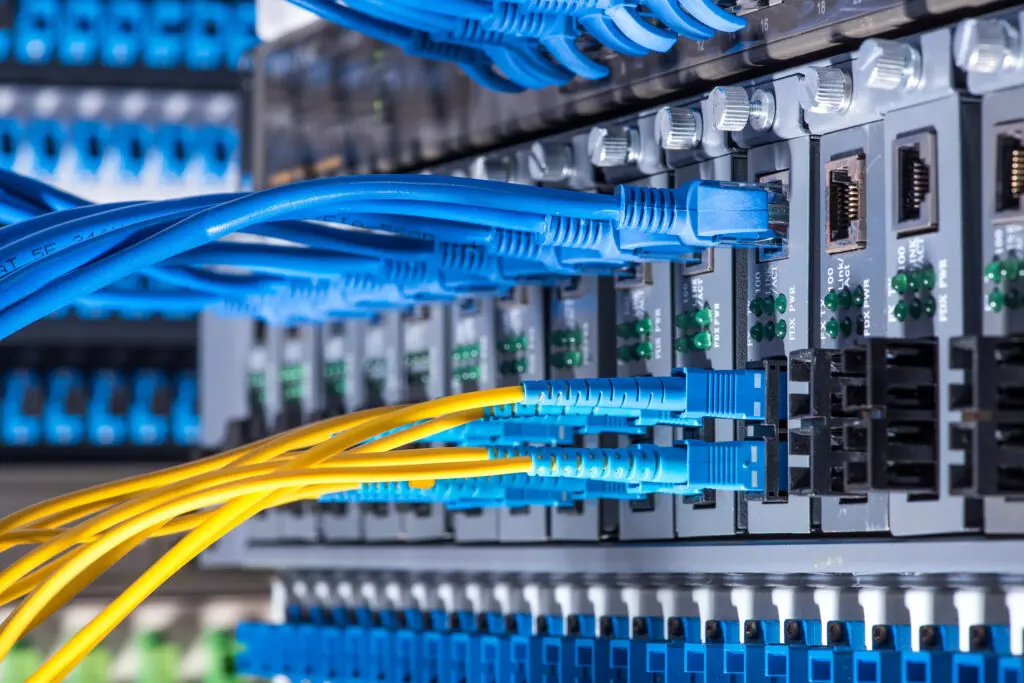
Category Data Cabling integrated with Fiber Optic cables and UTP Network cables connected to hub ports.
Types of Voice-Data Cables We Typically Installs
Explore the different cable types used in our installations.
CAT3 Cable
The levels of data categorize cabling systems they can sustain. Category 3, called Cat-3, is an unshielded twisted pair (UTP). Cat 3 traditionally has been used for telephones such as analog, electronic, or digital telephone systems. It is slowly being phased out, although we still have requests to work on these occasionally.
CAT5 Cable
Category 5 (Cat-5) cable is also a twisted pair cable for carrying signals. Cat-5 is used in structured cabling for networks like Ethernet, telephony, and video. Cat 5 is an older version of data cables. Due to the demand for Gigabit data speed, we also see Cat 5 data cables being phased out.
CAT6A Cable
The CAT6A standard supports higher data rates and is ideal for environments where higher bandwidth is required.
CAT5e Cable
Short for Category 5 Enhanced, Cat-5e network cabling is used as a cabling infrastructure for 10BASE-T (Ethernet), full duplex 100BASE-TX (Fast Ethernet) and 1000BASE-T (Gigabit Ethernet, or GbE) networks. Cat 5e is a happy medium between pricing and speed. Cat 5e can run gigabit and save money over Cat 6 data cables.
CAT6 Cable
Short for Category 6, Cat-6 network cabling is used as the cabling infrastructure for 10BASE-T (Ethernet), 100BASE-TX (Fast Ethernet), 1000BASE-T (Gigabit Ethernet, or GbE) and 10GBASE-T (10-Gigabit Ethernet, or 10 GbE) networks. Cat 6 is the most common data cable used today because of its standard Gigabit speed.
CAT6E Cable
Can support speeds of up to 10Gbps and frequencies of up to 600 Mhz. It is increasingly more popular as a tie cable between suites or buildings that are less than 100 Meters and much lower cost to fiber if the distance is pretty short.
Coaxial (TVI with Power)
Coaxial cabling with power cable are typically use in Security Camera Systems. We offer Coaxial TVI and Data cable installation for home and business. Do you already have your own cameras and just want us to help you with installation, no problem.
CAT6A Cable
It can support speeds of up to 10Gbps and frequencies of up to 500 Mhz. It is increasingly more popular as a tie cable between suites or buildings that are less than 100 Meters and a much lower cost to fiber if the distance is relatively short.
Types of Cable Jackets We Typically Installs
Cable Jacket Type: PVC
PVC jacket types can be used specifically for indoor or outdoor applications. PVC jacket cable can be used in homes and businesses. The application includes but is not limited to the inside warehouses, outdoor installations, inside and outside of homes. Note: PVC (Polyvinyl Chloride) emits toxic fumes when burning. Therefore, certain business spaces require the use of plenum cables.
Cable Jacket Type: Plenum
Plenum jacket cables have teflon jackets, which are considered fire-retardant, so they help minimize fire spread. Plenum cables are usually used in plenum space. What is plenum space? Plenum space can be above ceiling tiles or below floor. It’s the space where air conditioning and HVAC systems are used. Most office buildings that have drop ceilings are required to run plenum cables.
Cable Jacket Type: CMR
CMR-Multifunctional Communications Cable, Riser is constructed of premium PVC and is fire-resistant. Its self-extinguishing capabilities allow it to survive extreme temperatures in any type of setting. To demonstrate that they are sufficiently flame retardant to stop a fire from spreading from one floor to another, CMR-rated cables must pass higher standards of testing. It designates Ethernet cables that may be used in a building’s plenum, such as a dropped ceiling, raised floor, and other air spaces.
Cable Jacket Type: OSP
OSP-Outside Plant describes all of the hardware, wires, and other infrastructure that is situated outside of a facility. OSP Cable Jacket material is made to endure outside conditions without requiring a flame rating in order to be used within a building greater than fifty feet. You can extend your network outside and cover a sizable campus with OSP’s ability to retain performance in the face of extreme weather conditions, including as flooding, humidity, hot and low temperatures, and tearing and abrasion resistance.
Cable Jacket Type: Shielded
Unshielded cables are less expensive and simpler to work with than shielded cables because they lack the metallic shield that surrounds them. Homes and offices that require low voltage frequently utilize this kind of connection. Signal deterioration may result from other electrical equipment’ interference with unshielded cables. For most situations where there is no sensitive or important data transfer, short distance cable runs, and no electromagnetic interference (EMI), unshielded cables are a good option.
Cable Jacket Type: Unshielded
Unshielded cables are less expensive and simpler to work with than shielded cables because they lack the metallic shield that surrounds them. Homes and offices that require low voltage frequently utilize this kind of connection. Signal deterioration may result from other electrical equipment’ interference with unshielded cables. For most situations where there is no sensitive or important data transfer, short distance cable runs, and no electromagnetic interference (EMI), unshielded cables are a good option.
Cable Jacket Type: Armored
Compared to regular cables, armored cables include a metal protective covering that makes them more appropriate for direct burial. It is especially made for places where corrosion and mechanical damage are common. Armored cables are used to enhance the corrosion resistance and mechanical strength of the cable. It is most suited for direct burial laying in rocky locations and can be laid using any method.
Cable Jacket Type: Burial
Burial cable is suited for wet, dry, and humid situations and is made to tolerate direct exposure to soil and moisture. It is intended to be buried underground in a trench. A solid thermoplastic sheath surrounds each individual electrical conducting wire inside the cable, keeping moisture out and safeguarding the wires from harm. Direct burial wires are used in a variety of applications, such as fiber optics, irrigation, cathodic protection, pet fencing, phone and other telecommunication cables, running electricity, and tracers wire installations for underground utilities.