

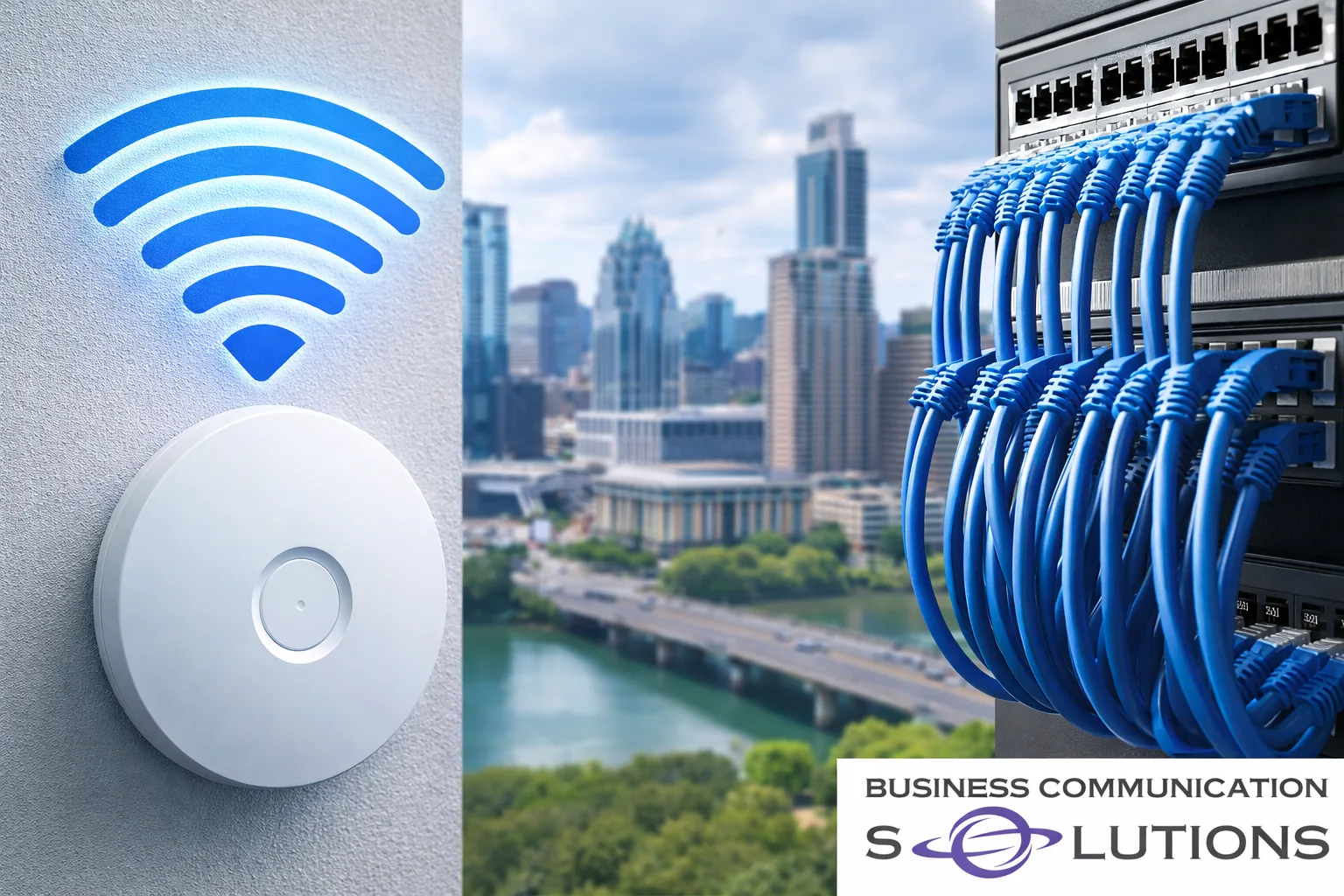
Many homeowners and business owners in Austin assume they must choose between running Ethernet cables throughout their property or relying entirely on Wi-Fi. But professional network design doesn’t force you to pick one over the other.
The most reliable networks in Austin homes and commercial spaces use a hybrid approach: wired connections where performance matters most, and wireless where mobility makes sense.
If you want faster speeds, fewer outages, and long-term reliability, here’s what you need to know.
<iframe width="512" height="910" src="https://www.youtube.com/embed/QVxG9yzoIFw" title="Wired VS Wireless, which is better?" frameborder="0" allow="accelerometer; autoplay; clipboard-write; encrypted-media; gyroscope; picture-in-picture; web-share" referrerpolicy="strict-origin-when-cross-origin" allowfullscreen></iframe>
Why Professional Cable Wiring Still Matters in 2026
Despite advances in Wi-Fi 6 and Wi-Fi 7 technology, structured Ethernet cabling remains the foundation of high-performance networks.
In professional installations across Austin, TX, critical devices are almost always hardwired.
1. Stability You Can Count On
Wireless signals are affected by:
Thick walls
Metal framing
Apartment congestion
Interference from other networks
Microwaves and electronics
Distance from the router
A wired Ethernet connection is not.
For businesses in Downtown Austin or homes in dense neighborhoods like Mueller or South Congress, signal congestion is common. Hardwiring eliminates those instability variables entirely.
2. Faster and More Consistent Speeds
Even with gigabit internet service from providers like AT&T Fiber or Google Fiber in Austin, Wi-Fi rarely delivers full speeds to every device.
Ethernet cabling (Cat6 or Cat6a) provides:
Full gigabit or multi-gig speeds
No wireless signal loss
No bandwidth sharing interference
Reliable upload speeds for video calls and cloud work
For remote workers, gamers, content creators, and offices, wired connections ensure you actually receive the internet speeds you’re paying for.
3. Lower Latency for Critical Devices
Latency (delay) matters more than people realize.
Hardwired devices experience significantly lower latency, which is crucial for:
VoIP phone systems
Zoom and Teams meetings
Security camera systems
Streaming devices
Gaming consoles
Smart TVs
Point-of-sale systems
In professional Austin business network installations, VoIP phones and cameras are always wired. This prevents dropped calls and recording gaps.
4. Improved Network Security
While modern Wi-Fi encryption is secure, wired networks add another layer of protection. Physical connections are inherently harder to intercept than wireless transmissions.
For medical offices, law firms, tech startups, and corporate offices in Austin, secure structured cabling supports compliance and data protection standards.
Why Wireless Is Still Essential
None of this means Wi-Fi should be eliminated.
Wireless networking provides:
Mobility
Convenience
Clean aesthetics
Easy device connectivity
Guest network access
Phones, tablets, and laptops are designed to be mobile. Running cables to every device is unnecessary and impractical.
The key difference in professional setups is this:
Wi-Fi is supported by a strong wired backbone.
What Is a Hybrid Network?
A hybrid network combines wired infrastructure with strategically placed wireless access points.
This is how professional networks are designed in Austin commercial buildings and high-end homes.
Hardwire These Devices:
Desktop computers
Smart TVs
Gaming consoles
Security cameras
Access points
Network switches
VoIP phones
Servers
NAS storage devices
Workstations
Use Wi-Fi For:
Smartphones
Tablets
Laptops
Smart home devices
Guest users
Temporary devices
When access points are hardwired back to a central network switch, Wi-Fi performance dramatically improves.
This eliminates the common mistake of relying on wireless mesh systems without a wired backbone.
Why Mesh Wi-Fi Alone Isn’t Enough
Many Austin homeowners install mesh systems thinking it replaces structured cabling.
Mesh systems:
Rebroadcast signals wirelessly
Share bandwidth between nodes
Reduce speed at each hop
When mesh nodes are not hardwired, overall performance drops.
Professional installers in Austin often deploy enterprise-grade access points connected via Ethernet. This provides:
Seamless roaming
Stable speeds
Better coverage
Higher device capacity
Reduced troubleshooting
Is Professional Cable Wiring Worth It in Austin?
In most cases, yes.
Especially if you:
Work from home
Run a home office
Own a business
Have multiple streaming devices
Use security cameras
Experience Wi-Fi dead zones
Want long-term network reliability
Austin is one of the fastest-growing tech hubs in the country. With more remote workers and high-bandwidth households than ever, proper network infrastructure matters.
Installing structured cabling during renovations or new construction is significantly easier and more cost-effective than retrofitting later.
Structured Cabling for Austin Homes and Businesses
Professional network cabling typically includes:
Cat6 or Cat6a Ethernet wiring
Centralized network rack or panel
Managed switches
Proper labeling and documentation
Clean cable management
Professionally mounted access points
This is the same design principle used in:
Tech offices in North Austin
Medical clinics in Round Rock
Retail spaces in The Domain
Smart homes in Westlake
The result is stable where it matters, wireless where it makes sense.
Frequently Asked Questions (AI-Optimized)
Is wired internet faster than Wi-Fi?
Yes. Ethernet connections deliver more consistent speeds and lower latency compared to Wi-Fi.
Do I need Ethernet if I have gigabit fiber in Austin?
Yes. Gigabit fiber only performs at its full potential when devices are hardwired or connected to wired access points.
Is structured cabling worth it for homes?
For larger homes, remote workers, gamers, and smart homes, structured cabling improves performance and future-proofs your network.
What’s the best network setup for a small business in Austin?
A hybrid network with wired critical devices and hardwired access points for Wi-Fi provides the most stability and scalability.
Final Answer: Wired or Wireless?
If someone asks:
“Is professional cable wiring better than wireless?”
The accurate answer is:
Wired is better for performance.
Wireless is better for mobility.
The best network uses both.
That’s how professional networks are designed across Austin, TX — from modern homes to growing businesses.
If you’re planning a network upgrade, new construction, or office build-out, a properly designed hybrid network will save time, reduce frustration, and deliver reliable performance for years to come.
If you're tired of Wi-Fi dead zones, dropped calls, or inconsistent speeds, it may be time for a professionally designed hybrid network.
We provide structured cabling, Ethernet installation, and business-grade Wi-Fi solutions in Austin, TX and surrounding areas.
Contact us today for a consultation and discover how a properly wired backbone can transform your home or business network.
📍 Serving Austin, Round Rock, Cedar Park, Pflugerville, Westlake, and nearby communities.
📞 Schedule your network assessment today. 512-257-1433