

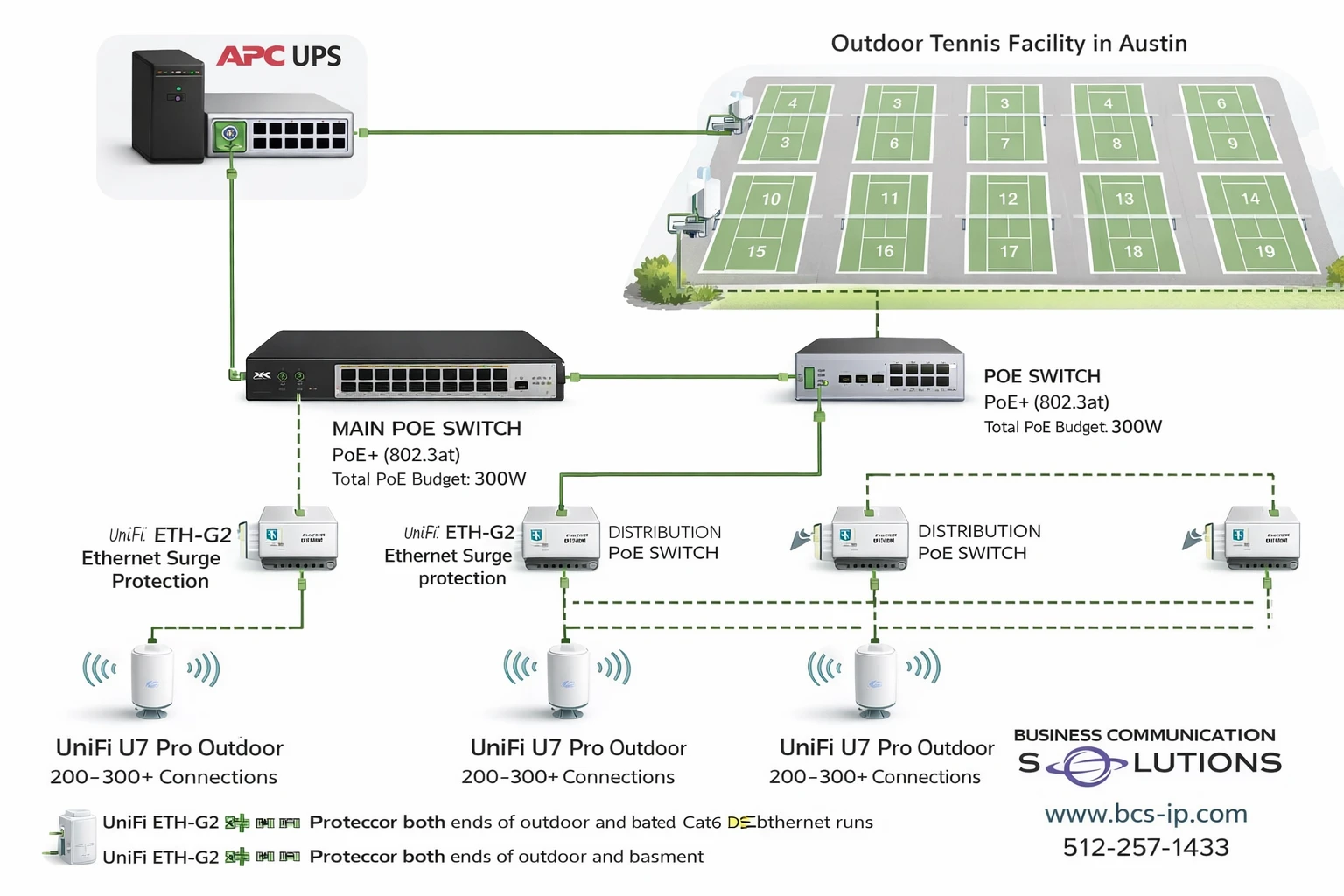
Outdoor Wi-Fi Installation in Austin Built for Reliability
Outdoor Wi-Fi installation in Austin requires more than access points. A reliable design includes PoE-powered switches to eliminate outdoor electrical outlets, high-capacity outdoor access points like UniFi U7 Pro Outdoor, proper PoE wattage planning, enterprise-grade surge protection, and scalable subnetting. For large venues such as tennis courts and sports facilities, layered Ethernet surge protection and properly sized IP networks are critical for performance, uptime, and long-term reliability.
This tennis facility Wi-Fi network was designed to:
Eliminate outdoor electrical outlets
Support hundreds of simultaneous users
Protect equipment from lightning and power surges
Scale for tournaments and future growth
Deliver consistent performance across all 18 courts
If you’re searching for outdoor Wi-Fi installation in Austin, proper design, PoE planning, and surge protection make all the difference.
Outdoor Wi-Fi in Austin has unique challenges—heat, long cable runs, and electrical storms. For sports facilities like tennis complexes, reliable connectivity requires more than strong signal strength. It requires proper power design, surge protection, access point capacity, and scalable network architecture.
For this project, we designed an outdoor Wi-Fi network for an 18-court tennis facility in the Austin area, using PoE-powered switching, UniFi U7 Pro Outdoor access points, enterprise-grade surge protection, and a /20 subnet built for high-density usage.
Why PoE Is Ideal for Outdoor Wi-Fi Installations
No Electrical Outlets Required at Access Points
Power over Ethernet (PoE) allows both power and data to travel over a single Ethernet cable. In outdoor environments like tennis courts, this approach provides major advantages:
No electrical outlets needed at poles or mounting locations
Reduced electrician costs and faster deployment
Flexible access point placement across courts
Centralized power control at the network rack
Remote power-cycling of access points for troubleshooting
Seamless UPS backup integration
Using PoE-powered switches, all outdoor access points are powered directly from the network infrastructure.
PoE Wattage Planning and Limitations
PoE design must be done carefully, especially in large outdoor environments.
Key PoE Considerations
Each PoE port has a maximum wattage limit
Each switch has a total PoE power budget
Cable length impacts available power at the device
Outdoor access points draw more power under load
High-performance outdoor access points typically require PoE+ or higher, particularly when supporting Wi-Fi 7 features and large client counts.
Best practice: always design PoE capacity with additional headroom to avoid instability during peak usage.
UniFi U7 Pro Outdoor for High-Density Tennis Courts
For this facility, we selected UniFi U7 Pro Outdoor access points, designed specifically for outdoor, high-capacity environments.
Why UniFi U7 Pro Outdoor
Weather-rated for Texas outdoor conditions
Supports up to 300 client connections per access point
Designed for high-density Wi-Fi 7 deployments
Excellent roaming performance across large outdoor areas
While 300 connections represents a maximum limit, real-world performance depends on user behavior, channel planning, and how client load is distributed across access points.
Surge Protection: Critical for Outdoor Wi-Fi in Austin
Austin and Central Texas experience frequent lightning activity and power fluctuations. Outdoor Ethernet runs act like antennas and must be properly protected.
UniFi ETH-G2 Surge Protection on Both Ends
For every outdoor Ethernet run, we are installing UniFi ETH-G2 Ethernet Surge Protectors on both ends of the cable:
One surge protector near the outdoor access point
One surge protector at the building or network entry point
This dual-ended approach:
Protects PoE switches from voltage spikes
Protects access points from lightning-induced surges
Helps prevent damage from ground potential differences
Increases long-term reliability of outdoor network equipment
APC Ethernet Surge Protection at the Core Network
In addition to field-level protection, the main PoE network switch is protected using Ethernet surge protection built into the APC backup battery (UPS).
This provides:
Surge protection for Ethernet lines entering and exiting the PoE switch
Power conditioning for the PoE switch itself
Battery backup during short power outages
Clean shutdown protection during extended outages
Layered surge protection—at the access point, cable entry, and network core—is critical for outdoor Wi-Fi installations in Austin.
Subnetting Strategy: Why a /20 Network Is Used
For a large outdoor venue, proper IP addressing is just as important as RF design.
Benefits of a /20 Subnet
4,096 total IP addresses
4,094 usable addresses for devices
Supports large crowds during tournaments
Allows seamless roaming across courts
Avoids IP exhaustion during peak events
Risks of Subnets That Are Too Small
Using a small subnet (such as a /24) can lead to:
IP address shortages
Clients unable to connect
Unstable user experience
Increased support calls
For outdoor sports facilities, undersized subnets are a common and costly mistake.
Managing the Risks of Large Subnets
While large subnets offer flexibility, they must be managed properly.
Best Practices
Segment traffic using VLANs
Separate guest, staff, and operational devices
Limit broadcast and multicast traffic
Improve security and troubleshooting
This approach maintains performance while allowing large-scale growth.
PoE Copper Cabling vs Fiber for Outdoor Wi-Fi
For this project, all access points and devices are powered using PoE over copper Ethernet, rather than fiber.
Advantages of PoE Over Copper
Power and data on a single cable
Faster installation and lower cost
Simplified maintenance and expansion
No fiber termination required at access points
Important Considerations
Copper has distance limitations
Outdoor-rated, grounded cable is required
Surge protection is mandatory in Texas environments
In many outdoor Wi-Fi designs, fiber is used for long backhaul runs with PoE switches located closer to access points. When copper is used throughout, surge protection and proper layout are essential.
Need Outdoor Wi-Fi Installation in Austin?
If you’re planning Wi-Fi for tennis courts, sports complexes, parks, schools, restaurants, or large outdoor venues, working with a local Austin-based network installer matters.
Business Communication Solutions specializes in:
Outdoor Wi-Fi installation in Austin and surrounding cities
UniFi access points and PoE network design
Surge-protected outdoor Ethernet installations
High-density Wi-Fi for events and sports facilities
Troubleshooting networks other vendors won’t touch
📞 Call us today: 512-257-1433
📍 Serving Austin, Round Rock, Cedar Park, Pflugerville, Leander, Georgetown, Buda, Kyle, and surrounding areas.
Local, responsive, and built for real-world environments—not cookie-cutter installs.